Showing posts with label Star Cider. Show all posts

Monday, October 23, 2023

Cider Review: Star Cider and Blue Barn Cidery's Folklore

It’s Halloween time, and this year looks like sunny warm weeks and rainy cold weekends. Our trips to the pumpkin patch might be more hurried amidst the blowing blustery conditions. The time at home with snuggly blankets, cozy candle scents, and pots of hot soup is more needed than usual. This season has many modes, and all facets of Autumn are welcome to me. This week’s cider was enjoyed with a potato and cider cider soup and hot crust bread toasted with cheddar. 

Today, I’m sharing my thought’s on Star Cider’s Folklore. Star Cider is a regional cider local to us here in upstate New York. The cidery is based in Canandaigua, New York. That's part of the Finger Lakes, for those unfamiliar. It was founded in 2014 and the current tasting room opened in 2019. I love this quote from the cidery’s website.

Cidermaking is not a destination, but a journey. On this journey, cider will continue to evolve as we discover new insights on the science of cider and unravel myths and legends about the processes used to make hard cider in the past. Cidermaking will continue to transform as we experiment with the fermentation process and through the use of fresh ingredients that complement the flavor of cider.

I had a great time visiting Star Cider with the Cornell and NY Cider Association Summer tour last year: https://alongcameacider.blogspot.com/2022/07/cornell-and-nyca-hard-cider-summer-tour.html

And in 2018 I finally shared my notes on the Wild Child Rhubarb by Star Cider: https://alongcameacider.blogspot.com/2018/07/cider-review-kite-and-string-ciders.html

I recommend checking out the Star Cidery website to learn more about current offerings and activities in the tasting room: http://www.starcidery.com/.

And here's a link to Blue Barn Cidery too: https://www.bluebarncidery.com.

Admittedly, I know less about Blue Barn Cidery out of Hilton, New York, but I look forward to learning more!

Here’s how Star Cidery describes Folklore 

Made with mixed heirloom apples from Blue Barn Cidery in Hilton New York this collaboration cider is guaranteed to impress!

Notes of green apple, peach, and pear give way to a dry Riesling-like finish. The perfect cider for a sunny day. 7% ABV.

Appearance: Intense sunflower yellow, brilliant, bubbly

The Folklore pours with a head, but the head didn’t stick around long enough for pictures. This cider vibrates with its sunflower yellow color; it’s so bold and bright! The cider is bubbly and brilliant.

Aromas: overripe apples, tangy tartness, gentle funk

This cider bubbles ripe apple aromas with fervor! I love the rich autumnal lushness I get here. The Folklore also smells just a touch funky in a tangy way. Other notes remind me of lemon, wild rice, and mushrooms.

Sweetness/Dryness: Semi-dry

I find the Folklore semi-dry, but it was a careful consideration to get there. I’d be curious to see the residual sugar and acidity.

Flavors and drinking experience: Bubbly, bittersweet, high acid

This cider develops as I taste it in a most pleasing way. The Folklore communicates with gentle bittersweetness. In mouthfeel, it’s creamy and rich; the fine bubbles move energetically through the cider. Like the majority of New York state ciders the Folklore gets lots of its ooph from its high acidity rather than tannins. 

Specific flavors associations that wafted through my mind were white grape and crème brûlée: something round and full. One of my favorite little surprises of this cider was its vanilla finish.

*


*Tattoo pictured is temporary: a remnant of my pirate costume. Sure looks great though, doesn't it?


Monday, July 25, 2022

Cornell and NYCA Hard Cider Summer Tour


I love to see apple orchards, but I’ve mostly gotten to visit them in the Fall. That’s amazing; I have no complaints, but I was so excited to get an invitation recently that would allow me to see an epic orchard in high summer. This past Friday, I got to go on the Cornell and New York Cider Association (NYCA) Hard Cider Summer Tour which includes a really special orchard and a sapling nursery among other fun educational and delicious stops. Here’s how the full day went!

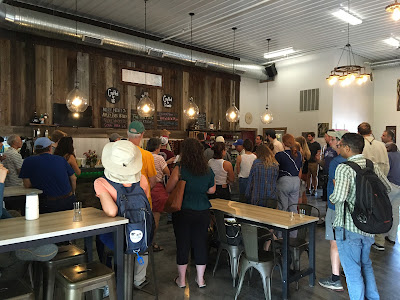
Star Cider in Canandaigua, NY

Visit Star Cider online here: http://www.starcidery.com/.

We started our day with a thorough tour of Star Cider with cider maker and co-owner, Cortni Stahl to learn about Star Cider’s story, how they make cider, and the unique considerations that continue to shape this cidery. Cortni showed us their fermentation space, tasting room and even shared pictures of the Airstream trailer that she and her cidery co-owner/husband moved into in order get their cidery dream off the ground.

One of the most interesting facts we learned at Star Cider was the range of fermentation times for their cider. The shortest time apple to glass is about 3 weeks which blew my mind. The  longest takes more than a year because of barrel aging. 

The other element of their production and sales that stood out is that in the tasting room, Star Cider is tapping and selling directly out of 5 bright tanks. That saves them tons of time and labor for all the steps usually required for kegging, bottling, or canning. These core ciders are the ones that the tasting room tries to have available all of the time, while many other ciders rotate in and out. Cortni spoke with us about how much she’s learned that their consistent fans want to try new flavors of cider. 

We finished our visit with a cider taste. I tried the Appley Ever After, a cider Cortni describes as being champagne inspired. It was very pleading, so I bought a bottle to bring home for myself later. 
                                    

Our next stop was my most anticipated of the day: the USDA Germplasm Collection!

Learn about the Apple Collection here: https://www.ars.usda.gov/northeast-area/geneva-ny/plant-genetic-resources-unit-pgru/docs/apple-collection/

Yes, that sounds like a mouthful, and the word germplasms might not immediately sound like an orchard. But this was a very special orchard tour.

Our host was Ben Gutierrez; he told us about the mission of the USDA’s apple germplasm collection. It’s very much a living preservation of apple genetic diversity. It’s also a wonderful collection of apple trees that can be used in other scientific studies. One of our coordinators, Dr. Greg Peck also spoke to us at this stop about his lab’s work. His lab uses the Germplasm to analyze and compare apples and apple trees for their different qualities in ways that directly affect the cider industry.

USDA germplasm in Geneva has approximately 52 apple species, 1800 cultivars, and 7k different trees. This blows my mind. I won’t be able to get all of the specific details shared correct, but lots of what we talked about was Malus Domestica and its various wild ancestors like Malus Sieversii and Malus Sylvestris.

Now, some researchers are studying the possibilities of rewilding apple trees: using the reintroduction of wild genetics in crosses to improve apple hardiness and disease resistance. I think my favorite phrase used was that apples have only undergone a “Soft domestication.”

Fireblight came up a few times as an important threat to domestic apple varieties. Other projects study acidity or tannins in the apple genome as well as fruit color, and disease resistance.

The Orchard has an open house on September 19, so that’s already in my calendar! This place was amazing. Just walking from tree to tree and seeing how different the plants are from one another inspires awe.


Lunch was a sumptuous taco buffet and Churro cookies provided by Lake Drum Brewing! We enjoyed our tacos outdoors on a shaded pavilion. The sweet potatoes al pastor filling was simply amazing. What a perfect choice! Thank you, Chef Luis and Lake Drum Brewing! I wish I had paused long enough to take pictures of the spread before simply inhaling it. At this point, some folks brought out ciders they’d brought to share informally. There were some treats, but it was too hot and too much driving and touring ahead for me to feel particularly investigative.

Cornell Agritech Craft Beverage Lab

You can visit Cornell’s Craft Beverage Institute online here: https://cals.cornell.edu/cornell-craft-beverage-institute

Folks at the Cornell Craft Beverage Institute divided us into three groups and took us through the Craft Beverage Analysis Lab, the Vinification & Brewing Lab and the Fruit & Vegetable Processing Pilot Plant. Each was very different, but all were fascinating. Anna Katharine Mansfield showed us the beverage analysis lab and talked us through what tests they do and for what sorts of businesses; there are tons! At the Vinification and Brewing Lab, we saw what small scale experiments can be done to learn about different yeasts, single varietal ciders, and all sorts of beverage experiments that don’t make sense to do on a commercial scale. We also saw apple presses in the fruit processing pilot plant. Everything was so shiningly clean with lots of Cornell Red!

Red Jacket Orchard: Juice Processing and Fruit Tree Nursery

Learn about the juice, the farmstore, and the orchards online: https://redjacketorchards.com/

Again we had to split up here after getting some history of Red Jacket from second generation famer Joe Nicholson. It was a fascinating story; his father moved the family from poultry farming on Long Island to a finger lakes fruit stand. Now the operation is substantially larger and more varied. On the nursery side, we heard from Matt Murphy and more from Joe who spoke with more passion for pears and apricots than perhaps anyone I’ve ever heard. I’ll quote, “We are indebted to apricots, substantially.” Red Jacket is planting 20 acres of apples a year in the high density orchard style. He honestly made me want to turn my neighborhood green space into a fruit orchard. It’s a dangerous dream.

Third generation Red Jacket man Brian Nicholson toured us through the juice facility; and discussed their distribution history, production processes and took many questions from our curious crowd. The ingenuity and scale of the place was mind-boggling! 

Finale: Cider Pub Crawl with Lake Drum Brewing and Star Cidery

Visit Lake Drum Brewing online here to learn about their ciders: http://lakedrumbrewing.com/

We started at Lake Drum Brewing where we could taste some ciders and discuss what we learned. I already know I’m fond of a few Lake Drum Ciders, so it was a happy reunion. It was fun to see the grad students, orchardists, and cider makers mingling and getting to know one another casually after our big educational day of touring. 

I honestly didn’t even head to the Star Cidery for a second because I had a concert to catch in Trumansburg. What an amazing day!

Thanks so much to the New York Cider Association and Cornell’s Cider Program for making it happen! 

New York Cider Association: https://www.newyorkciderassociation.com/

Cornell Hard Cider Resources: https://hardcider.cals.cornell.edu/

Tuesday, July 3, 2018

Cider Review: Kite and String Cider's King of Hector and Star Cider Wild Child Rhubarb


Welcome to July! The month of fireworks, fresh tomatoes, and sweet corn is here. There are heat waves and cool lakes here in the heights of upstate New York summer. Even though I know I could cover dozens more canned ciders, I can’t neglect other formats. This matters to me especially because I know of some really special ciders never see the inside of a can. I promise to visit to the most summery format soon and often, after a whole month of cans, I do want to review two ciders I tasted in big beautiful 750ml bottles.

Quick geeky aside! Formats aren’t just an issue of convenience. Formats often imply serving size. A lot of folks don’t look at ABV when choosing a cider or pouring a drink. And cider ABVs vary wildly. One can often turns into one serving, whereas a 750ml bottle is more often treated as 4 distinct glasses of cider no matter the ABV. I think it’s awesomely strategy to be cognizant as either a drinker or host when dealing with a beverage that doesn’t have a standardized pour size, glassware, format, or consistent ABV. Read those labels, friends!


Kite and String’s King of Hector

Kite and String is the local cider at the heart of the Finger Lakes Cider House in Ovid, New York. They are also known as Good Life Farm as that's the umbrella farm that makes everything possible. The big news around her is that the Cider House made it into USA Today’s list of the the top 10 Cider Bars in America! That’s huge for a farm-based destination in rural New York. The place really is beautiful, fantastic, delicious, and worth a trip.

I've enjoyed Kite and String Ciders before. 

The Barrel Rye: http://alongcameacider.blogspot.com/2015/12/cider-review-good-life-ciders-barrel-rye.html

The Cazenovia: http://alongcameacider.blogspot.com/2015/09/cider-review-good-life-ciders-cazenovia.html

I've enjoyed the Hickok at a few special dinners including:

Thanksgiving: http://alongcameacider.blogspot.com/2016/11/happy-to-pickcider-for-thanksgiving.html

and a Finger Lakes Locavore Birthday Dinner:  
http://alongcameacider.blogspot.com/2017/09/finger-lakes-cider-week-and-birthday.html

Read about both the Finger Lakes Cider House and Kite and String Cider on the website: http://www.fingerlakesciderhouse.com

Or see what the company (and the farm animals) are up to on Facebook: https://www.facebook.com/KiteandStringCider/

Today I’m reviewing a cider that I wouldn’t ordinarily be able to get because the King of Hector was a special release for a pairing dinner and the Kite and String Cider Club. Luckily for me, dear friends of mine are in the club, and they were generous enough to bring this bottle over to share. 

Read the full write up with tons of background information here: http://www.fingerlake
sciderhouse.com/blog/2018/6/27/two-more-weeks-to-get-in-on-king-of-hector

I’ll share just an excerpt
Tasting and Cider Maker Notes: Gripping acidity typical of wild seedlings and crab varieties. Slow fermentation (2 months). Hands off approach with little intervention. High acid cider aged well over the winter with beautiful aromas and unique flavor. We were excited to keep this extremely small lot separate that  season and this cider was filtered and bottled as our last traditional method product of the year. 8.4% ABV
And the pairing suggestions:
We think this cider drinks like a dry, Spanish champagne style. It is crisp, long lasting, and acidic, and embodies the heat of 2016. Drink it as a starter to open up your guests’ palates and imaginations, with light appetizers like dried fruit or with lightly fried fish or potatoes.

Appearance: straw, translucent, no bubble 

This cider looks beautifully translucent, though not brilliant. I’ll call the color straw but it warmth and golden hue are more inspiring than the name strictly denotes. I don’t see any bubbles when I pour a glass, but I’m sure they’ll there once I taste the cider. 

Aromas: riple apples, bitter orange, meyer lemon, limestone

I smell citrus and apples, but having seen a few mentions of Spanish stylings (although of sparkling wine rather than Sidra), I did expect some sour notes or even volatile acidity in the smells. They weren’t there. The aromas were more fruity and restrained which suits my preferences well. I did get some fun salivary response.

Sweetness/dryness: Dry

This is a dry cider. Other features that I’ll describe later only enhance the perception of dryness. Super duper dry.

Flavors and drinking experience: dry, high acid, medium tannins, citrusy

The cider tastes dry and acid driven, but it’s not sour. The acid flavors I taste are more fruity and less funky. The cider doesn’t show volatile acidity or acetic acid. Instead, and more to my personal tastes, I get tons of citrus notes from the King of Hector. It tastes like Meyer lemons, Seville orange, and just a little bit of tropical fruit. 

The King of Hector does have some tannic presence. That’s notable and enjoyable. As the notes on my phone say, “Drrrryyyyy.” The combination of medium tannins, very high acidity, and a dry cider come together to emphasize a dry, zesty, tasting experience. The King of Hector tastes lithe and a little light. I didn’t necessarily expect that because of the 8.4% ABV, but it was seasonally perfect and very refreshing. 

This is a cider for wine and cider lovers. It’s definitely sophisticated and austere. It’s precisely the kind of cider that I like to have even before I put food on the table. The King of Hector has enough to say on its own to be a delightful conversation starter. 

Star Cider's Wild Child Rhubarb 


Confession time, I’ve had these tasting notes for too long! I tasted Star Cidery’s Wild Child Rhubarb for the first time in October of 2016 at a Finger Lakes Cider Week event. I met folks from Star Cidery and learned what I could about the operation. I liked it so much that I got a bottle for later. I consumed that with friends later that winter, taking tasting notes and squirreling them away. I must have hidden them too well, as I’ve just rediscovered them. 

Star Cider makes and sells cider in the greater Rochester, New York area. The company was founded in 2014, but the founders were home cider makers long before. Reading about Star Cider’s approach, I am struck by the focus on process. Cider gets described as a journey with an expectation of change and evolution. That’s appealing  in that’s both grounded in the realities of learning a new business but also in that openness to changes is how improvements happen.  This is my first review of anything by Star Cider.

Read all about the company and the ciders on the web: http://www.starcidery.com

Or check in with the Star Cider Facebook page: https://www.facebook.com/StarCidery/

Today’s review is of one of Star Cider’s seasonal releases, the Wild Child  Rhubarb.

Let’s start with the official description, “Rhubarb: Fresh heirloom rhubarb is hand-picked at its peak ripeness and blended with cider made from a mix of dessert apples. This cider is crisp, tart, and tastes like biting into fresh rhubarb.”  6.9% ABV

Unofficially I learned that this cider uses 1.5 lb of rhubarb per gallon of juice. The finished cider is back sweetened with sweet cider after being fermented to dryness. The flavor was inspired by the cidermaker’s grandmother and grandfather’s recipes.


Appearance: brilliant, warm canteloupe color, visible bubbles

I wish I had better pictures of this cider. The color really is lovely with a shade that reminds me of canteloupe and beauitful clarity. 

aromas: strawberry, celery, and candy dust

Oh my goodness wow! These aromas are so neat! I definitely smell strawberry, rhubarb and apple, but also celery! There’s also so sweet and powdery candy dust lurking in the background!

Sweetness/dryness: Semi-dry

This might be on the slightly sweeter side of semi-dry, but it has a powerful acidity that keeps all sweetness in check. 

Flavors and drinking experience: rhubarb zing, herby, strong sparkle

Like many of my favorite ciders both in the region and more generally, acidity orchestrates the whole experience. The Wild Child Rhubarb just vibrates with zingy acidity. But that’s not all that’s going on. I’m also completely sold on the herbaceous and vegetal notes. They integrate beautifully and really cement that rhubarb plus apple combination. This cider really works.

Part of what I enjoy about the Wild Child Rhubarb is the mouthfeel. Part of that owes to it’s powerful tartness. The cider feels fresh and medium bodied with strong bubbles. There’s also a nice backbone of apple behind everything. And I relish the long cold finish. My first tasting was in a varied set of ciders, and it really stood out. My second experience with this cider was with vegetarian chili, wheat crackers, and sharp cheddar. Both worked, but I’d love to try it with summery foods when I see this cider again.