Showing posts with label oaked. Show all posts

Monday, May 22, 2023

Cider Revew: Runcible Cider's Idyll Acres and Cider Awards!

It’s awards season in the cider world! At the end of this week’s review, I’ll link to the results for the Great American International Cider Competition (GA Cider), the Great Lakes International Cider and Perry Competition (GLINTCAP), and the Cidercraft Awards. I was lucky enough to judge for the GA Cider Competition, which is part of the Raise a Glass Foundation. And I’ve enjoyed judging for GLINTCAP many times, and I hope to make it up to Michigan for next year’s competition. But since I was home this weekend, I was able to try a lovely cider from the west coast. It was a nice balm for the GLINTCAP FOMO. Here’s my review of Runcible Cider's Idyll Acres.

This is my first ever review of a Runcible Cider, so here’s a bit about Runcible Cider from the about page of the website.

Runcible Cider  is our family orchard and cidery on the rocky prairie above beautiful, tiny Mosier, Oregon. We grow over 1000 traditional cider apple trees, and we ferment these apples as well as heirloom apples grown on neighboring orchards in the Columbia River Gorge.

I got this cider as part of the Northwest Cider Club. Here’s a link if you’d like to see what the club is up to these days: https://nwciderclub.com/

I love that Runcible Cider’s website highlights some of the cider apples grown there for the ciders. Here’s the list they share. How many of the varieties do you know?

Bulmer's Norman

Campfield

Dabinett

Kingston Black

Nehou

Porter's Perfection

Roxbury Russet

Wickson Crab

Yarlington Mill

Chisel Jersey

Bedan

Harrison

Golden Russet

Ashmead's Kernel

Herefordshire Redstreak

Bramley's Seedling

These are some amazing apple varieties. Five of my favorites appear, so my hopes for this cider are high! Here’s how the Runcible Cider's website describes the Idyll Acres.

Idyll Acres -- Apple Contemplation Series

7.6% ABV

Bittersweet and bittersharp cider apples have the perfect building blocks for a structured, balanced cider. This blend of French and English cider apples come from one orchard in Oregon, Idyll Acres, where we taste and blend on the fly right at harvest. This Series celebrates the potential of cider made exclusively from cider apples, aged over a year and a half. Our goal is to put it on your go-to list for bubblies!

Lightly aged in Bourbon barrels, apple and citrus peel, spicy touch of oak. Dry.

Appearance: brilliant, scattered bubbles, warm straw

The Idyll Acres looks very traditional in the glass with a gorgeous brilliance and just a few visible bubbles. The color reminds me of sunlit hay, hence warm straw.

Aromas: overripe apples, peach, barrel, icy apple slush

What inviting barrel-aged characteristics! The Idyll Acres wafts vanilla and toast along with mellow overripe apples. These are just the first layer, secondarily I scent icy apples slush, along with notes of peach, melon, and stone dust. 

Dryness/sweetness: Dry

As promised, this is a dry cider. I love a dry barrel aged cider because it's possible to have sweet associated flavors and scents without the physical taste of sweetness, and that’s a wonderfully delicate balance. Idyll Acres achieves it beautifully!

Flavors and drinking experience: tannic, muted fruits, vanilla, full bodied

My first impression is that this cider is tannic, chalky and woody. The barrel characteristics plus the heirloom cider fruit combine to enhance some astringence pleasantly. I get lots of vanilla in the midpalate and in the finish: vanilla everywhere really. Idyll Acres is fruity in a muted way; overripe apple notes predominate with secondary stone fruits.

I love that this cider is both dry and full bodied. The bubble intensity comes across as pleasantly supportive of the overall drinking experience.  My co-taster and I enjoyed this cider with a simple spring supper of blacked salmon, baby rainbow potatoes and green beans. The complexity of the cider certainly got the take center stage and deserved it!

Now for the competition results! I encourage you to visit each of these sites to find out who is winning big in the northeast, midwest, and out west. And when you get a chance to taste any of these winners, take it! 

Great American Cider Competition medals: https://cider.raiseaglassfoundation.com/

GLINTCAP: Best in Class and Major Awards: https://glintcap.org/

6th Annual Cidercraft Award Winners: https://cidercraftmag.com/announcing-the-sixth-annual-cidercraft-awards-winners/

Thursday, January 7, 2016

Cider Review: Wandering Aengus Cider's Dry Oaked


So, it's time for a first but also a second for Along Came A Cider. This is the first time I've gone back and reviewed a second bottling of the same cider. In this case, I'm returning to Wandering Aengus' Dry Oaked Cider. This is a pleasure for me because I so enjoyed the 2011 Dry Oaked.

If  you want to compare the two, start with the previous review:  http://alongcameacider.blogspot.com/2013/11/cider-review-wandering-aengus-dry-oaked.html 

Or, for even more context, one of my very first cider reviews was of Wandering Aengus' Bloom:
http://alongcameacider.blogspot.com/2013/01/cider-review-wander-aengus-bloom.html

This is what the reverse of the Dry Oaked's bottle says about the cider, "Wandering Aengus Ciders are crafted from blends of traditional cider apple varietals renowned for their complexity.Oaked Dry is a blend of bittersweets and sharps that offer rich tannins and spicy aromas with a mild oak finish. This sophisticated dry cider pairs well with rich and aromatic foods: prosciutto, salami, or stinky cheeses. Orchards: Bittersweets: Newberg, Culver & Salem, Oregon Sharps: Hood River and Ashland, Oregon"

This vintage of Wandering Aengus Cider's Dry Oaked was Bottled June 2012 and hasan ABV of 8.0%  A bottling of this cider won a 2015 GLINTCAP gold in english style category. 

Appearance: clear, glowing embers, few visible bubbles

Wow, look at how dark this color is! It is the only cider I've seen that looks to me like glowing embers in winter hearth.
Aromas: Boozy, soft, and appley

This smells like wets apple skin, alcohol, and firewood. Even if I didn't know something of what was coming, these aromas would clue me into the tannins of this cider. It even smells the tiniest bit like iron.

Dryness/sweetness: DRY!

This dry is a true dry.It's more astringent and velvety than most ciders, and that makes me love it.

Flavors and drinking experience: oaky, dry, tannic, rich and complex

This tastes very oaked. I know fire keeps touching the sensory impressions I have of this cider, but somehow the oakiness seems like oaky charcoal in a pleasing and good way. Or at least the wood near the charcoal. It is both highly tannic and moderately acidic. This combination gets some serious salivary gland action.

But this cider isn't just sensation; the flavors build a complex yet unified whole. The initial oakiness graciously gives way to lighter flavors like lemongrass and green tea. In the background I get just a little bit of phenols and turpentine. 

Texturally, the cider gives mild carbonation. Its rich mouthfeel is distinctly not caramel but rather buttered toast. I love what a slow drinking thoughtful cider this is. Have the Wandering Aengus with blue cheese, fig, roasted onion, perhaps altogether on foccacia. 

This cider is perfect for a long discussion of anything enjoyable and just a little decadent. 

Tuesday, January 6, 2015

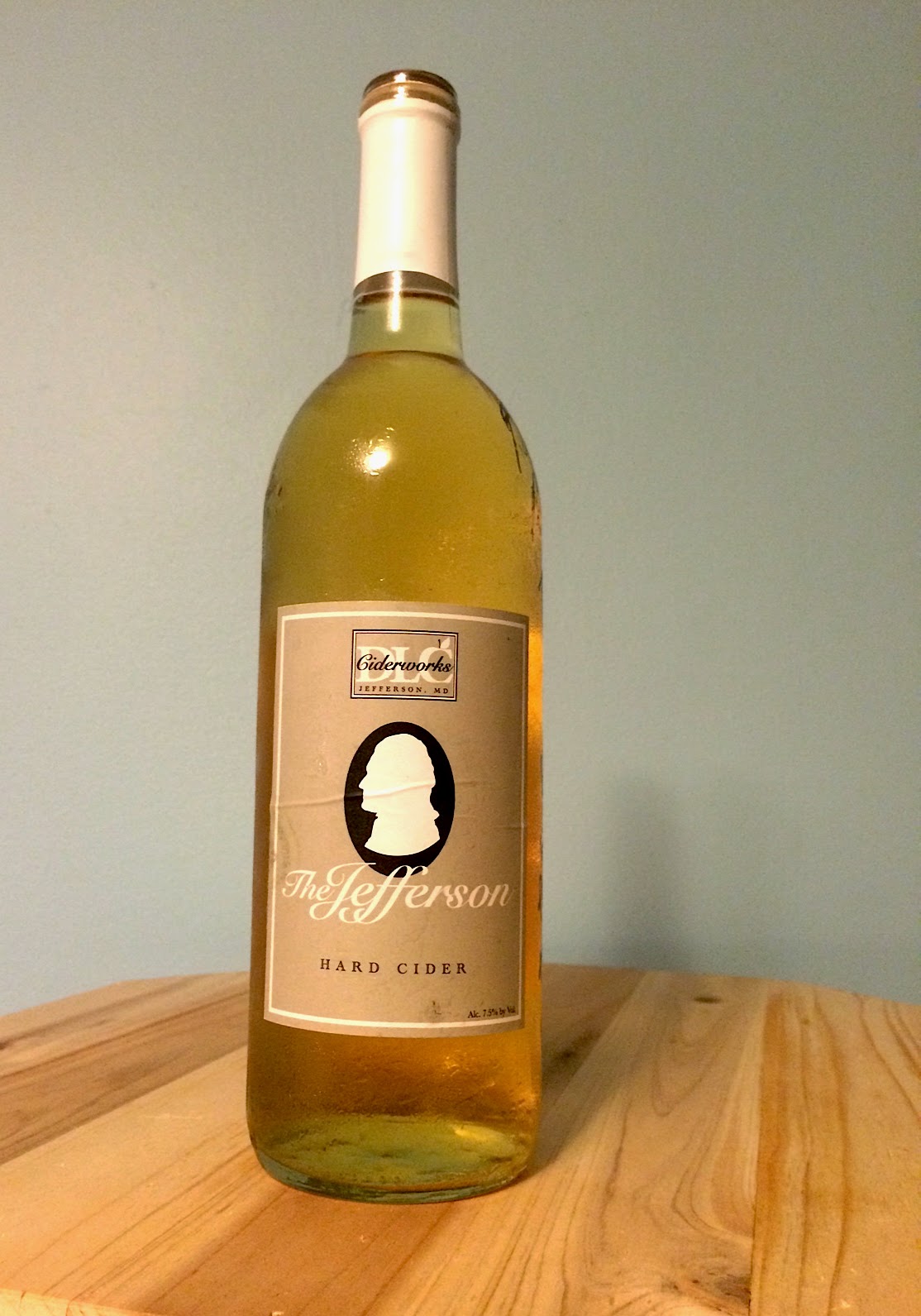
Cider Review: Distillery Lane Ciderworks' The Jefferson

Casual at-home dinners with friends are the mainstay of my social calendar. I prefer them to most other kinds of hanging out year round, but I appreciate them even more when the weather is cold and going out just sounds uninviting. What could be better than a nice meal with wonderful people? With cider. And dessert. And more cider with dessert. Besides, I think cider pairings are much easier to coordinate this way. So, before I get cooking for tonight's dinner, I though I'd post about another cider that I've only experienced as my contribution to a friend's little supper gathering.

This is yet another of my Mid-Atlantic ciders shared with me by Patrick Huff, writer of Cider Nation (http://cidernation.wordpress.com) and Crafty and The Beast (http://craftyandthebeast.com). He also coordinates regular cider chats on Twitter under the hashtag #ciderchat. These happen most Thursday evenings; he often hosts cidermakers or other field experts for good times.

For my preview run-ins with Distillery Lane Ciderworks and an introduction to their cider business and identity you can check out my review of Distillery Lane Ciderwork's Kingston Black:
http://alongcameacider.blogspot.com/2014/05/cider-review-distillery-lane-ciderworks.html

And here's a link to my review of their Traditional Dry Sparkling Cider: 
 http://alongcameacider.blogspot.com/2013/08/cider-review-distillery-lane-ciderworks.html

I'll let Distillery Lane Ciderworks introduce The Jefferson themselves:
Thomas Jefferson was a renowned cidermaker and orchardist in his time. One of his favorite apples was the Newtown Pippin, an apple first grown in New York. Historically, this apple was exported in large quantities to Great Britain (the Queen liked Newtown Pippins so much that British Parliament lifted the import duty only on this apple variety). It is no surprise that the Queen liked the Newtown Pippins so much: on a trip to Europe, Jefferson once notoriously declared, “they have no apples here to compare with our Newtown Pippin!” For our hard cider, The Jefferson, we press Newtown Pippins, along with other vintage cider apples, to create an off-dry cider. The cider is also aged with American oak to achieve an old-time flavor, reminiscent of the oak barrels that Jefferson would have used when brewing his ciders. The Jefferson is perfect with smoked fish and meat. 2014 GLINTCAP gold medal winner.
One last fact to note before we get started; this cider offers up a hearty ABV of 7.5%.
 

Appearance: brilliant, brassy, mellow

At first I thought the color was copper mixes with grass, but my dinner companions questioned this. More yellow and less orange, they said. We thought some more and agreed on a mellow brass color. It doesn't show any bubbles, which indicates to me that this could be a still cider. Brilliant with zero haze.

Aromas: boozy, butterscotch, oak

None of us smelled very much fruit on the nose of this cider. I smelled butterscotch, which most folks found as well. Someone said it smelled like booze or like a heavily-oaked chardonnay. The aromas aren't particularly strong.

Dryness: off dry/semi-dry

Now that we're all tasting this, a few people are getting more fruit, but the oak and tannins dominated the experience for me and a couple of my fellow tasters. The official description of off dry is arguably accurate, but I feel like it would be just as fair to nudge that up to a semi-dry. There is some sweetness, but not very much.

Flavors and drinking experience: green apple, vinous, butterscotch

Wow! Such an interesting experience! This is 98% still— the petillance is almost like a very weak 9 volt battery on the tongue, just a tingle and no more. The primary flavors different folks observed were minerals, green apple, vinousness, butterscotch, and popcorn. The mouthfeel was a touch light and thin, which I only notice particularly because the oak flavors don't seem to combine naturally with such a light mouthfeel. The booziness does warm the mouth but that's the primary tactile sensation.The Jefferson provides lots of different flavors, light and dark, pleasant and interesting enough, but they don't really interact in a way that offers up totally coherent complexity. It tastes toi me like the tannins could be from oak chips or rods, and not the more mellow oak of barrels. I'm not 100% certain though.

We shared this with a homemade pasta dish with cream sauce, broccoli, and mushrooms. Meat eaters added some roast chicken as well. I do think the seasonality and warmth of everything paired well together. The Jefferson certainly does strike me as a winter cider.

Though I'd love to ramble more about the pleasures of ciders and dinners and good company, it is time for me to get up and go to the kitchen to prepare for tonight's dinner party adventure. Cheers! Here's to a happy and tasty 2015!


Thursday, May 22, 2014

Cider Review: Distillery Lane Ciderworks Kingston Black

I received a fabulous array of awesome Mid-Atlantic ciders; many thanks to Patrick Huff of Cider Nation (http://cidernation.wordpress.com) and Crafty and The Beast (http://craftyandthebeast.com). He also does regular cider chats on Twitter. Check out the hashtag #ciderchat most Thursday evenings, and you'll find something useful and interesting. So tonight's cider review comes from that store of deliciousness.


I'm reviewing Distillery Lane Ciderworks' Kingston Black.

Previously, I reviewed their Traditional Dry Sparkling Cider. Here's a link to that review: http://alongcameacider.blogspot.com/2013/08/cider-review-distillery-lane-ciderworks.html
You'll find a lot more background information on the company there.

I made an interesting discovery when looking up Distillery Lane's website. It is not only available at http://distillerylaneciderworks.com but also now at http://ciderapples.com  Both sites offer identical information on the cidery's history, name, event and availability. What I could not find enough information about was their selection of ciders, althrough their Facebook page has more info there than the main website. https://www.facebook.com/DistilleryLane

 To set this scene, this cider came with me to a dinner party with my husband and a couple of his fellow professors and their families. Lovely lovely people, many of whom already love good cider and wine. So of course, I asked them to help me taste through a bottle of something new over dinner. So these observations are not the products of only my fevered brain, but also those of my companions.

This is what Distillery Lane Ciderworks says about their Kingston Black.
It is rare amongst the hundreds of apple varieties grown today that one apple has proper amounts of sugar, acid, and tannins to make a high-quality, single varietal cider. Kingston Black, an apple first grown in Somerset, England, is one of these rare apples. Highly prized, but scarcly cultivated in America today, Kingston Blacks grow very well in our orchard.  It has a wonderful tartness and lovely finish. Serve chilled with poultry, mild fish or pork. We also bottle limited quantities of Kingston Black sparkling.
Additionally, I'd like to note ABV listed is 7.5%.


Appearance: Rich honey color, brilliant

This poured beautifully. Everyone appreciated the rich golden honey color. No visible bubbles to speak of, but I really didn't expect them in a still cider.

Aromas: oak, hints of apples, brightness


The Kingston Black smells fresh and bright, but with a hints of fresh apples, cherry, honey, and a few  interesting phenols. The oak aromas really jumped out at us after a few seconds.

Sweetness: semi-dry

Like other single varieties of cider I've tasted, issues of sweetness and dryness are almost swept aside because the flavors are about so much other than that. Even so, this has some sweetness and fruitiness, but it is more dry than sweet. Definitely a semi-dry in my book.

Flavors and drinking experience: complex, tannic, buttery

Because of the tannins and oak, this tastes in some ways like a REALLY gentle whiskey, or a bit of warming apple brandy. The individual notes in that experience are butter with a whipped cream aftertaste. Rather like the overall impression made by some bourbon barrel aged ciders, one can get hints of pancakes. Someone in the group astutely tasted notes of white chocolate. I found it a little minerally. The cider has very high tannins and fairly low acid. It tastes relatively little like apple, but we could detect bits of apple core, skin, and wood.  The Kingston Black tastes best when you let it flow over the whole tongue. You warm up to it and the cider itself is warming.

 We enjoyed this cider with grilled salmon and asparagus, wild rice salad with dried cranberries, and chocolate covered strawberries. The meal was delicious and the cider stood up well to all of those varied strong flavors. This is a cider to enjoy with food. I liked it plenty, but overall I still find cider blends to be more approachable than most single varietals. None the less, this one hit plenty of high notes for me. I love tannins, and this cider delivered them in spades.

Thanks again to my dinner companions and cider sharers!

Friday, November 15, 2013

Cider Review: Wandering Aengus Dry Oaked

 
It has been far too long since I've reviewed anything by Wandering Aengus Ciderworks out of Washington State. The last time I reviewed one of their cider, I took a look at the Bloom cider. You can check out my review here: http://alongcameacider.blogspot.com/2013/01/cider-review-wander-aengus-bloom.html.  Their website appears to be undergoing a certain degree of transition right now, but you can still read about their ciders. http://www.wanderingaengus.com/wordpress/

Tonight I'm reviewing their Dry Oaked Cider. I can provide the official stats and description as offered by Wandering Aengus:

Orchards: Hood River, OR & Lebanon, NH
Dry and spicy
“mild clove bite”
Pairings: Salami or Stinky Cheese
ABV 6.8% (2009) 8.4% (2011)
Available in 16.9oz and draft
1/2 & 1/6 barrel kegs – Limited Run Vintage 2011

It's very neat that they share where they sourced the apples, in this case from Hood River, Oregon and Lebanon, New Hampshire. I wish the description gave a bit more in the way of apple varieties or tasting notes, but this is still a nice amount of information. Let's see how this goes.


Appearance: Brilliant, Gamboge, almost no bubbles

Looking at the Dry Oaked cider, I had to find some webpages that list different shades of orange. This thrills me because I have so often referred to shades of yellow, but this is the first time I've gotten to refer to shades of orange. After delightfully thorough consideration, I'd say the color is Gamboge. That word was a new one to me; it refers to the deep orange/yellow pigment used to dye Buddhist monks' robes. What a wonderful excuse to learn new things.The cider is brilliant and pours with Belgian lace

Aromas: wood, fresh apples, light pear and honey notes playing in the background

What a delightful smell! At first the wood just dominates but after a moment and a few repeated sniffs, I could detect the apples, pears, and honey.

Drinking Experience and Flavors: Dry, tannic, acidic, woody

This dry cider tastes so cleanly farmy, which sounds odd because often farminess and gamey flavors go together with funk. But this remarkably different. The Dry Oaked cider gets it farm notes from the combination of acidity and tannins. So much wood! This enchants me because of how well the balance works. The cider gets its liveliness from the acidity, depth from tannins, and restraint from the dryness. Gosh, I'm impressed. I love love the woodiness. It tastes like almost sucking on a barn beam in a way.

Though the cider has some natural sparkle, it isn't at all distracting or overpowering. The finish lingers smoothly. Overall, this is a remarkably drinkable cider for one with real complexity, dryness, and body.

I recommend cooking with this and drinking it at the same time. My husband used it with some good butter to saute mushrooms. This brings out the farminess and earthiness beautifully. We then used those mushrooms on top of pasta with basil pesto and sun-dried tomatoes (from my father's garden). Yeah. It worked out amazingly well for something fairly improvised.

 If you don't want to cook your own meal while drinking this cider, I don't blame you. Wandering Aengus' Dry Oaked cider serves up enough complexity to deserve its own focus. Perhaps then drink it while someone else is cooking something earthy, rich, and marvelous. Cooking is an excellent spectator sport afterall and this cider can keep anyone entertained.

Thursday, October 10, 2013

Finger Lakes Cider Week Special Review of Redbyrd Orchard Cider's Starblossom 2012

 We're more than halfway through with this year's Finger Lakes Cider Week, and I'm both very happy and very tired at this point. We've had wonderful activities that range from the educational to the indulgent and most everything in between. Tomorrow night is my last big event. I'll be pairing ciders and cheeses with the fine folks at The Cellar D'Or on State Street on the Ithaca Commons from 5-8pm. We'll have New York, regional, and international selections in both cheeses and ciders, and the whole event is completely free. Come by and taste a few things and mingle with your fellow cider lovers. I've been doing my cheese research for the event, and I'm pretty stoked to share some wild and funky cheeses. Delightful!

Anyhow, I'm blogging tonight to review another local Finger Lakes Cider by Redbyrd Orchard Cider. This is a relatively young company, but one of the founders, Eric Shatt, has been fermenting various beverages since his teenage years and came to cider professionally after several years in the local wine industry. Last year this company was one of the founding members of the Finger Lakes Cider Alliance along with 7 other cideries. I think this statement found on their website tells me the most about their goals as cidermakers, "We grow heirloom, wild seedling and European cider apples to produce unique and complex artisanal ciders."You can check out the rest of their website here: http://redbyrdorchardcider.com/.


Tonight, I'm reviewing their oaked cider, the Starblossom 2012. This is what the folks at Redbyrd Orchard say about their Starblossom cider: "Bottle conditioned and barrel aged in french oak, Starblossom is a heavy yet elegant cider with a nose of spice and vanilla, smokey cloves and dried fruit.  Exquisite with a fine ring of bubbles in your glass and a warming creaminess of effervescence in your mouth. An excellent pairing with a spicy lamb tangine, pasta nestled in a delicate cream sauce, roasted pork loin, or even on it’s own as a celebratory drink." I've not had many oaked ciders, so I'm extra curious about how dramatic the oak's effects will be on the cider and what that will be like. Those I've had a few; Some use highly flavorful boozed-up barrels for strong notes of the previous barrel occupants like bourbon or whiskey. Others use more subtle neutral barrels to up their tannins, using the wood as one more way to give their ciders structure. Two very different directions.

Appearance: Brilliant, pale, creamed honey

This looks to be a petillant or lightly sparking cider from the pours I'm seeing. Not very many visible bubbles. Beautiful brilliance and very pale color. It has the barely off white color of creamed honey through the cider looks anything but opaque.

Aromas: fresh apples, a bit of warm vanilla, perhaps some more tropical fruits

Luscious notes of fresh apples just open right up as soon as I smelled this cider. The other notes aren't as strong, but I did smell some warm vanilla and tropical fruits, mostly banana.

Sweetness: Semi-dry

The Starblossom isn't very sweet, but the fruits on the mid-palate definitely translate into some sweetness for me. When listening to others respond to the sweetness or dryness of this cider, I've heard a range of opinions, everything from noting it as pleasantly almost sweet to extremely dry. Palates vary.

Flavors and drinking experience: crisp, mildly fruity, wood on the finish

Well now I can definitely tell that Redbyrd uses their oak more for structure than for intense flavors. The cider makes its impression primarily on its crispness and firm structure. This cider drinks well and enjoyably for me, but my husband found it a bit rough and imperfectly balanced. The fruits only really come into play in the mid-palate but enjoyably so. The wood from the oak is most noticable in terms of flavor in the finish for the Starblossom.

I had this with a blue cheese and then again later with a hearty fall grain salad. It worked with both but I think the creaminess and intensity of the blue cheese made for an especially fun pairing. The zesty outspoken cheese relied a bit on the stability of the cider and the cider benefited from the excitement.